
Blog 69: Is your Narrator a Right Know-it-all?


Howdy, partners! What have you guys been up to this week? Maybe you have been juggling the house, kids and work. Perhaps you have had meetings or appointments. You may have spent time on your latest story. When I’m out and about, I often look at the others around me and wonder what their lives are like, what are they thinking about and what challenges do they have that I could never know from just glancing at their faces. However, if you were writing from a third person omniscient viewpoint, then you would know everything about all your characters and their world. A person cannot so much as fart without you hearing it and probably smelling it too!
The omniscient viewpoint, this godlike narrator that knows all and sees all is how the majority of stories used to be written from the bronze age: the Mesopotamian Epic of Gilgamesh, the Iliad, and Beowulf were shared orally by bards. These narrators could even reach into the minds of the gods and tell their secrets.

It has been used in Charles Dickens’ literature, Lord of the Flies by William Golding, Lord of the Rings by J.R.R. Tolkien, Pride and Prejudice by Jane Austen and Dune by Frank Herbert. It was the go-to story-telling style of fairy tales, the narrator that looks on and reports everything that is happening like a journalist who doesn’t miss a thing, or that nosey neighbour on your street who is always at their window. If you don’t have one, it’s probably you. Come on, don’t deny it!
Though not as popular today, there are still some stories with this type of narration, such as the famous children’s book collection: A Series of Unfortunate Events by Lemony Snicket (1999-2006), The Book Thief by Markus Zusak (2005), and The Mothers by Brit Bennett (2016).
“There was nothing to stop Mr. Poe from noticing that the children were not at all comfortable, but he was a man with a great deal on his mind, and so he merely smiled and looked at his wristwatch." (A Series of Unfortunate Events by Lemony Snicket).

Above we can see how the narrator knows how every character is feeling and what they are thinking. The main characters are the children, but this narrator can tell us what everyone is up to, which builds a bigger picture of what is happening and what is to come.
Have you attempted to write from this POV or been considering it? Well then, it’s your lucky day, because I’m going to look into the positives and negatives of doing just that: -
Pros
Maximum Scope: ideal for stories where you want to show a lot of information and characters such as epic fantasies, historical sagas, or sprawling plots in Sci-Fi or multi-generational family dramas. It allows writers to cover entire landscapes, shift timelines, and manage large casts more easily.
Dramatic Irony: The narrator can share secrets or impending dangers that the characters are entirely unaware of, building suspense.
Distinct Narrative Voice: It places the "narrator" at the forefront. The narrator can offer humorous commentary, moral insights, or clever observations outside of character dialogue.
No "Info-Dumping" Restrictions: Instead of contriving unnatural flashbacks or explanations, the narrator can directly tell the reader necessary backstory or world-building details.
Cons
Emotional Distance: Because the story is told from the narrator's perspective rather than from inside a character's direct experience, readers may feel emotionally detached from the characters.
The "Telling, Not Showing" Trap: Omniscience often forces authors to simply tell the reader what is happening or how a character feels, rather than immersing them in the scene.
Hard to Execute: It can be difficult to write successfully. The author must carefully control the narrator's voice, so it doesn't accidentally fade into an inconsistent style or devolve into erratic "head-hopping" (failing to anchor the reader to a specific perspective).
Lower Internal Tension: Knowing everyone's thoughts and ultimate outcomes can accidentally bleed tension and mystery from the narrative if not handled correctly.
What next?
If you are itching to give it a go, have an idea for a story that you feel would fit into the pros, above, and you are up for a challenge, then here are a few tips to help you on your way: -
Narrator's Voice
Establish a persona: Your narrator isn't invisible. Decide whether the voice is warm and conversational, like Lemony Snicket, or detached and reportorial, or witty and judgmental.
Keep a consistent tone: The language used by the omniscient narrator often requires a more elevated, lyrical, or wise prose style to distinguish it from the characters' internal voices.
Info and Pacing
Use dramatic irony: Because the narrator knows everything, you can reveal secrets that the characters are completely unaware of, building suspense or humour.
Don’t give it all away: Just because the narrator knows the future or every character's darkest secrets doesn't mean you should reveal everything at once. Strategically withhold information to maintain tension. You may want to have surprise elements in here to keep them guessing and wonder what is going to happen next. So, choose what you want to tell.
Avoid Head-Hopping
Establish clear transitions: Head-hopping happens when you abruptly bounce from one character's inner thoughts to another's without warning. This is quite jarring and can cause confusion, making the reader wonder who is thinking what.
The narrator as the filter: Instead of jumping directly into a character's mind, have the narrator observe them and provide insight, then pan out and observe another character. In this way, the narrator remains the anchor of the story.
Show vs. Tell
Balance your exposition: The omniscient voice can make it a little too easy to "tell" the reader exactly what is happening or what a character feels. Make sure that emotional arcs and crucial action scenes are still "shown" rather than summarised.
As another fun example of this style and what you can do with it, here is a short story I found on Facebook, posted by I Know, I Need To Stop Talking on 18 March 2018. It’s a comical (and slightly naughty) take on the children’s schoolbooks (Oxford Reading Tree and authored by Roderick Hunt). As a parent who has read many of these books with my two girls, I found this alternative to be hilariously delightful. Are you sitting comfortably? Here we go.
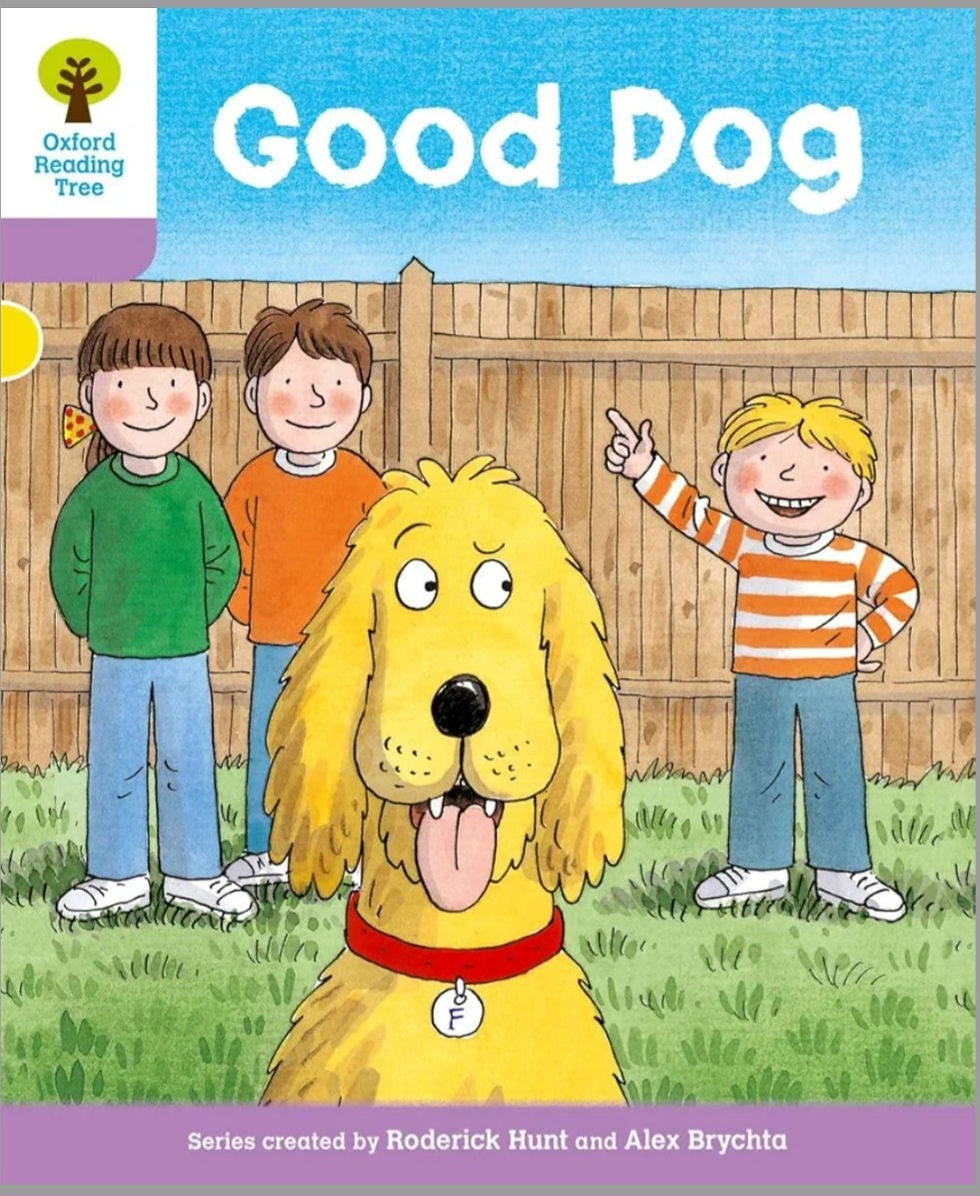
This is Biff.
This is Chip.
This is Biff and Chip's homework.
Biff and Chip are required to write down ten examples of fronted adverbials.
Biff and Chip have not a f*ing clue what a fronted adverbial is.
This is Mum.
Mum has not a f*ing clue what a fronted adverbial is either.
"We don't know what a fronted adverbial is," whinge Biff and Chip. "This homework is impossible. You will have to help us."
"It's not my homework, it's your homework," says Mum, thanking her lucky stars that she did not have to engage in any of this fronted adverbial b*ll*cks when she was at school.
This is Dad.
Dad still struggles to distinguish between a noun and a verb, and would not know a fronted adverbial if one came up and punched him in the face.
Biff and Chip think for a moment about asking Dad for help.
They decide to Google instead.
This is Mrs May.
When Mrs May went into teaching she honestly believed she would be able to spend her time helping children to love learning. And putting on plays. Mrs May loves a play. She did not realise that a love of learning would not feature on the National Curriculum at all, and that she would instead be forced to meet a series of impossible and continuously moving goalposts which successive governments would put in place, and have to teach her classes about ridiculous concepts such as fronted adverbials which, in all honesty, are only ever likely to be of use if they end up becoming professors of linguistics. Or primary school teachers.
If truth be told, Mrs May has not a f*ing clue what a fronted adverbial is either.
This is Floppy the dog.
Floppy holds no truck with fronted adverbials.
Floppy eats the fronted adverbial homework sheet.
Floppy knows that he is a f*ing liability, and waits to be told so.
No one is more surprised than Floppy when the entire family gather around and tell him, "Oh GOOD dog Floppy."
Floppy feels this is positive proof that some good can come from fronted adverbials after all.
Later at school, Biff and Chip are, for the first time, able to legitimately use the excuse: "My dog ate my homework."
Mrs May breathes a secret sigh of relief that that is one less set of incomprehensible and entirely incorrect homework that she has to plough through and suggests to the class that they will all put on a play instead to celebrate.
*****
I hope you found that as much fun as me to read, and it gave you a little more idea how you can delve into the different characters when the story is told by an omniscient narrator.
Until next time, happy writing and no head hopping. We don’t want our readers to get dizzy now, do we?


Comments